Linux and OpenWrt on a FortiWiFi-60E firewall, reverse engineered from the vendor binaries
Boot chain
The BIOS only boots Fortinet’s own flatkc image. I decoded its header, acceptance rules and ARM handoff from the vendor kernels, and rebuilt the device tree from the live system.
Linux shell
Linux 6.6.144 on four Cortex-A9 cores, with a patched UART driver and a console fix traced to an empty /dev in the initramfs. First shell on 29 October 2026.
Storage
The eMMC host contract came out of the installed FortiOS kernel. Multi-block commands wedge the controller, so the driver uses single blocks and enforces read-only unless writes are enabled.
Network
The NP6Lite network processor has no public driver. I decoded its TX path from the vendor’s ftk.o and wrote one: WAN1 links at 1000 Mbit/s and answers ping 5 of 5. Receive after a cold boot from eMMC is still open.
OpenWrt on eMMC
OpenWrt 24.10 is installed on eMMC partition p2, read back and hash-checked before the swap, with two earlier kernels kept as rollback copies. It boots on its own after a power cycle.
Switch and Wi-Fi
The BCM53128 switch answers with its chip ID, but per-port interfaces are not proven. The QCA988X Wi-Fi radio is found behind the PCIe bridge and loads its firmware; scanning and an access point are not proven.
Proof
Live captures from the appliance running the port, 22 November 2026.
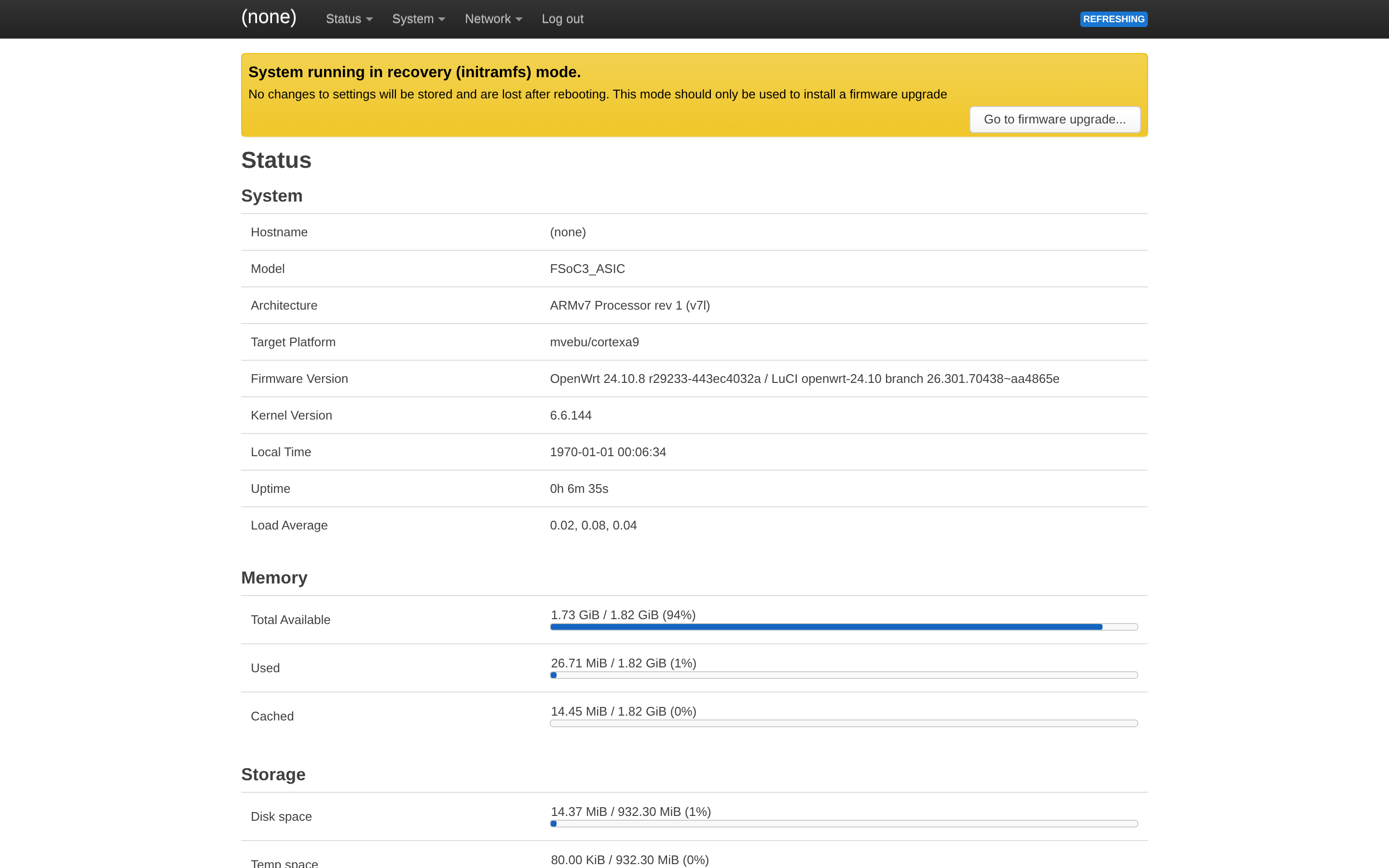
OpenWrt web interface
LuCI served by the appliance over WAN1: model FSoC3_ASIC, OpenWrt 24.10.8, kernel 6.6.144. The root filesystem runs from RAM, which is why LuCI shows its recovery banner.
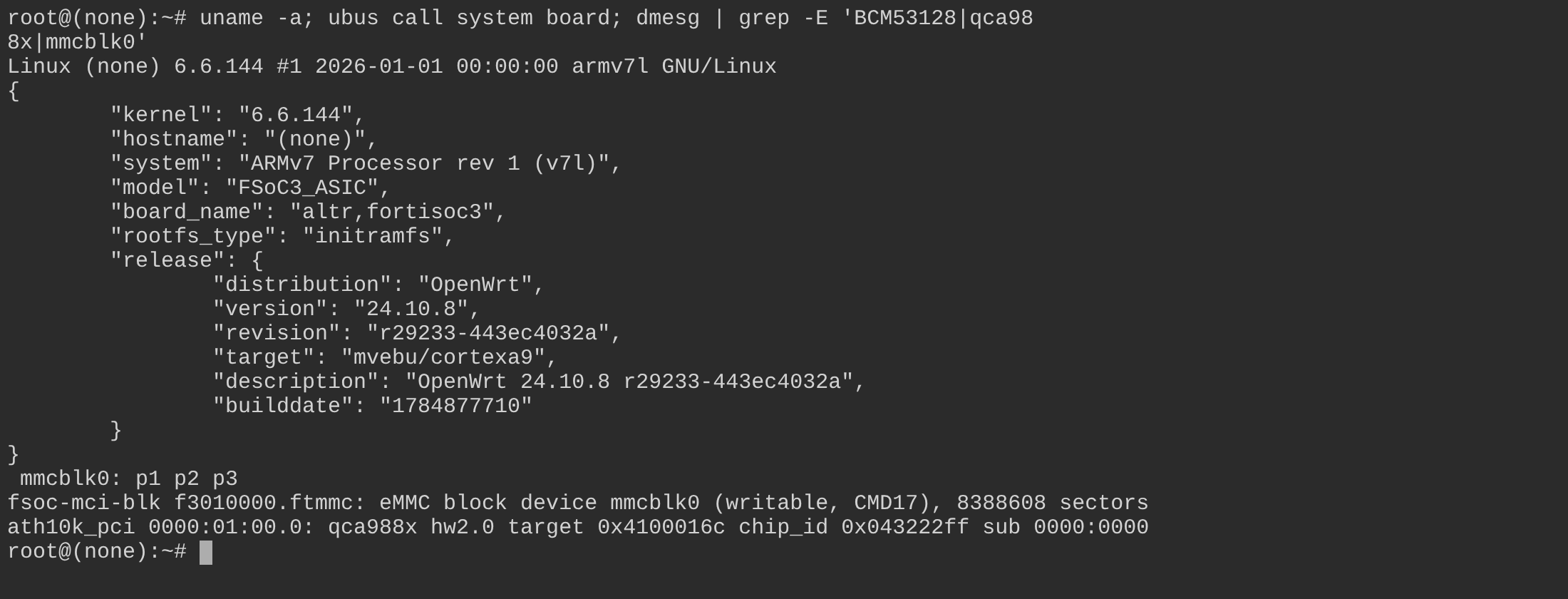
Serial console
A browser terminal attached to the appliance’s serial console: kernel, board identity, and the eMMC and Wi-Fi drivers from the kernel log.
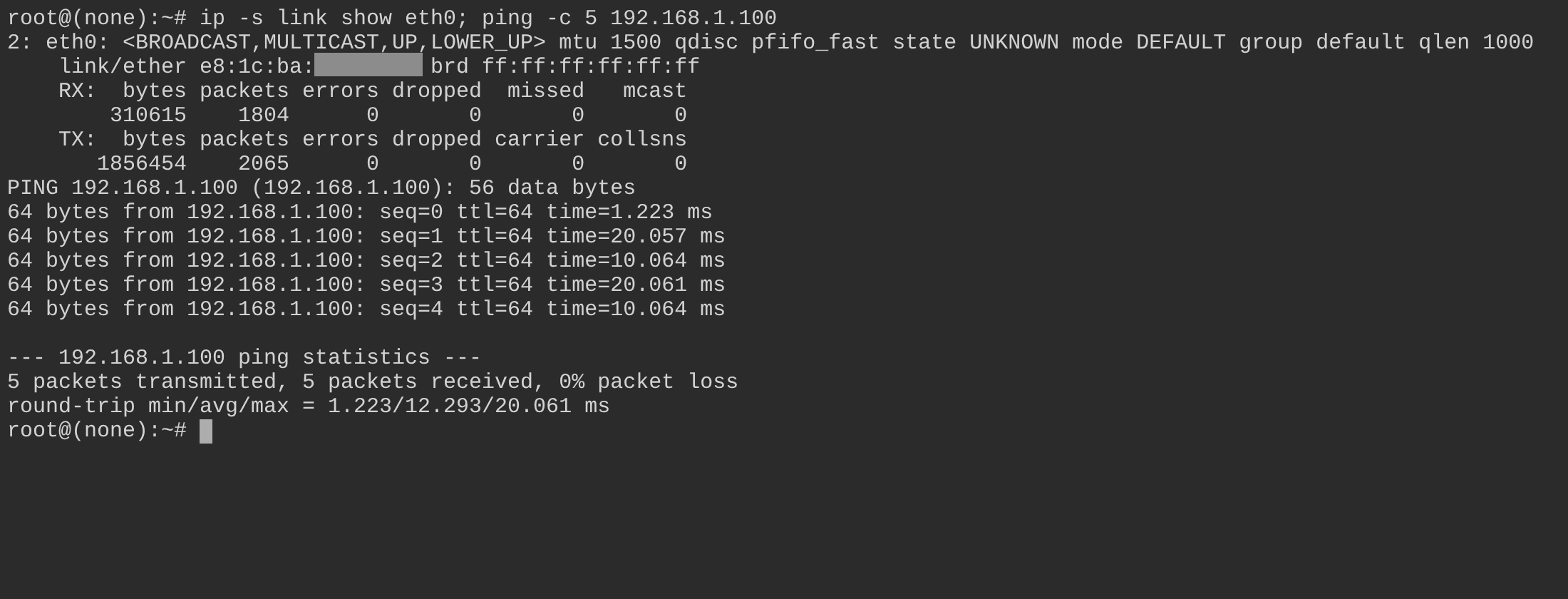
WAN1 traffic
WAN1 (eth0) receive and transmit counters with no errors, and a 5 of 5 ping to the lab host. The device half of the MAC address is blacked out.
What
Linux on a firewall that only ever ran FortiOS. The FortiWiFi-60E has a Fortinet ARM SoC, an NP6Lite network processor and no public documentation. It now boots Linux 6.6 and OpenWrt from its own eMMC and survives a power cycle.
Why
I wanted to work below the abstraction. A firewall appliance is a capable ARM computer locked to one OS. Porting Linux to it meant learning the boot chain, storage and network hardware from the vendor’s binaries and a serial console.
How
Reverse engineering, one gated step at a time. I decompile the vendor kernels and BIOS in Ghidra, write drivers against what they show, and RAM-boot every image over TFTP first. Claims in the docs are tagged observed, inferred or unknown, every image is named by its hash, and every kernel install is read back and hash-checked, with a rollback copy kept.
Stack
- Kernel
- Linux 6.6.144, ARMv7 (4× Cortex-A9), Device Tree
- Drivers
- eMMC host, NP6Lite Ethernet, BCM53128 switch, PCIe bridge, restart handler, in C
- OS
- OpenWrt 24.10, BusyBox
- Reverse engineering
- Ghidra, binutils, vendor FortiOS kernels and BIOS
- Lab
- Serial console, BIOS TFTP boot, dnsmasq, Proxmox container
- Checks
- SHA-256 per image, offline verifiers, acceptance harness